NIPHO Conference 2025

At the beginning of June Juliane was invited to speak at the International Conference on Perovskite Thin Film Photovoltaics and Perovskite Photonics and Optoelectronics (NIPHO25) taking place at the University of Cagliari in Sardinia. A great opportunity to represent the group and for scientific exchange with others researchers in a delightful setting. Many thanks to the organisers for the invitation and the wonderful event!

A group of about 40 researchers taking a group picture together

New Paper: Photostable Inorganic Perovskite Absorber via Thermal Evaporation for Monolithic Perovskite/Perovskite/Silicon Triple-Junction Solar Cells

We are pleased to announce our latest research advancement demonstrating, for the first time, the successful monolithic integration of an all-inorganic perovskite top cell into a perovskite/perovskite/silicon triple-junction solar cell. In this work, we report the fabrication of CsPbI₂Br perovskite films using thermal co-evaporation at room temperature, completely eliminating the need for any post-deposition annealing treatment. The resulting films exhibited a bandgap of 1.88 eV and showed remarkable photostability, with no signs of halide segregation even after 3 hours of continuous light exposure. The fully integrated triple-junction device achieved a stabilized power conversion efficiency of 21%, improving to 22% under ambient conditions and without encapsulation. This study marks a critical step toward the scalable, solvent-free fabrication of multi-junction solar cells and sets the stage for further development of industrial-grade, ultra-efficient photovoltaic technologies.

👉 For more information, read the full article: http://doi.org/10.1002/pip.3923 

New Paper: Tuning Self-Assembly of Hole-Selective Monolayers for Reproducible Perovskite/Silicon Tandem Solar Cells

Controlling the thickness and orientation of hole-selective self-assembled monolayers (SAMs) has long posed a challenge in the field of perovskite-based solar cells. In our most recent publication, we employ in situ angle-resolved X-ray photoelectron spectroscopy to examine the impact of annealing temperature on the thickness and orientation of the prototypical 2PACz. Our results demonstrate that increasing the annealing temperature beyond the typical range of 100°C to 150°C leads to a decrease in SAM thickness from approximately 5 nm to 1 nm, while simultaneously improving its packing density. As a result, the interfacial passivation quality of the 2PACz/perovskite layer is enhanced, thereby improving the performance of fully-textured perovskite-silicon tandem solar cells.

https://doi.org/10.1002/smtd.202401758

New Paper: Reducing Losses in 3J Solar Cells

High open-circuit voltage (VOC) is a key advantage of two-terminal triple-junction solar cells, as the voltages from individual sub-cells add up. To fully harness this potential, it is crucial to identify and minimize voltage losses in each sub-cell.

In this study, we identified the high-bandgap perovskite top cell as the primary source of VOC loss in perovskite/perovskite/silicon triple-junction solar cells. By enhancing the bulk quality of the perovskite and optimizing its interface with the electron transport layer, we significantly improved the top cell’s VOC. As a result, our triple-junction cells achieved an impressive VOC exceeding 3.00 V.

Additionally, we applied sub-cell selective iVoc imaging—for the first time in perovskite-based triple-junction solar cells—to confirm the source of this VOC improvement.

Check out the full paper here:

https://onlinelibrary.wiley.com/doi/10.1002/solr.202400645

New paper: Efficient fully textured perovskite silicon tandems with thermally evaporated hole transporting materials

Fully textured perovskite-silicon tandem solar cells are revolutionizing the solar industry by offering higher efficiency and compatibility with existing silicon production lines. However, for these advanced cells to reach commercial markets, scalable manufacturing methods are essential, not just for the perovskite layers but for all functional components.

One crucial layer is the hole transport layer (HTL), which ensures efficient charge carrier transfer and minimizes energy losses. Self-assembled monolayers (SAMs) are commonly used as HTLs due to their ability to form smooth, efficient interfaces with the perovskite layer. However, the traditional spin-coating method for applying SAMs poses challenges on large, textured silicon surfaces, often resulting in uneven layers that compromise performance.

To address this, we investigated thermal evaporation as an alternative HTL deposition technique. Thermal evaporation provides uniform layer application on textured surfaces, making it a promising solution for large-scale production. Our research revealed that the thickness of thermally evaporated HTLs significantly affects two key performance metrics: open-circuit voltage (VOC) and fill factor (FF). By optimizing HTL thickness, we achieved remarkable efficiencies: ~30% for 1 cm² cells and ~26% for 4 cm² devices. This breakthrough demonstrates that thermal evaporation is a scalable and effective method for producing high-performance tandem solar cells, paving the way for affordable and accessible solar technologies.

https://pubs.rsc.org/en/content/articlelanding/2024/ee/d4ee03899a

Master Thesis Topics in Perovskite Solar cell research

Perovskite based solar cells have in the last years become a dynamic research field which promises to change the way we will produce electricity in the future. In our research group we work on the deposition of perovskite thin films and their use in solar cells especially tandem solar cells. We are a team of 20 group members who come from a variety of countries, scientific disciplines ad career stages. For spring 2025 we are looking for students who are interested to join us for their master thesis research project. We work experimentally and it can take a while to learn the needed techniques, so we typically aim to have students in our group for at least 9 months. Depending on the requirements of your course this may be best done by combining HiWi time with the master thesis. Our group is based at the Fraunhofer Institute for Solar Energy Systems (Fraunhofer ISE) and the INATECH Institute of the technical faculty of University of Freiburg. We welcome Freiburg master students from a variety of courses including physics, sustainable systems engineering, chemistry, and other related subjects.

Below is a brief description of some of the projects we are currently offering. If you are interested in doing your thesis with us please contact Dr. Juliane Borchert (juliane.borchert@ise.fraunhofer.de) with a CV, transcript of grades, and some information about the course you are taking.

Topic A) Tailoring the Hole Transport Layer Properties for High-Quality Perovskite Thin Films with the Hybrid Evaporation/Spincoating Method (daily supervision by Oussama Er-raji)

Fully-textured perovskite silicon tandem solar cells are regarded as a strong candidate for next generation high-efficiency photovoltaics. In this architecture, the perovskite film is formed via the hybrid evaporation/spincoating method that allows a conformal coating on large silicon pyramids. However, perovskite films deposited with this method usually suffer from incomplete conversion (residual PbI2 at the perovskite/hole transport layer (HTL) bottom interface), which limits their efficiency. While literature reports have demonstrated that additive engineering can improve the conversion, it often comes at the detriment of stability.

The aim of the master thesis is to enhance the perovskite conversion via an innovative approach based on tuning the properties of the substrate (layer below the perovskite). For this purpose, multiple classes of hole transport layers, including self-assembled monolayers and small molecules, will be selected and tested. Investigation of the HTL layer properties will be performed to evaluate the resulting changes. Furthermore, structural, morphological, and opto-electrical layer characterization of the perovskite absorber will be carried out to gain insight into the influence of the HTL on the formation of the absorber. The different sets of information collected from single layer analysis will be used to improve the efficiency of perovskite single junction solar cells (on ohmic textured silicon substrates).

Topic B) Comparative Analysis of Silicon Substrate Geometry on Perovskite-Silicon Tandem Solar Cell Performance (daily supervision by Mohamed Mahmoud)

We are offering a master’s thesis position to explore the impact of silicon substrate geometry on the performance of perovskite-silicon tandem solar cells using fully evaporated route. Specifically, this project focuses on the effect of changing silicon substrate structures—from planar to nano/micro-textured geometries—on the overall efficiency of solar cells. Textured substrates are known to reduce reflection losses, which could significantly enhance performance, but their implementation in tandem solar cells presents several challenges, such as issues with deposition methods, voltage losses, and varying crystallization dynamics of perovskite layers.

New Paper: Tuning Perovskite Crystal Growth Dynamics Using Additives on Textured Silicon Substrates

Perovskite silicon tandem solar cells hold an immense promise as a new emerging technology as they showed efficiencies that broke the single junction limit. Growing conformal perovskite thin film layer on top of textured Si substrates in the micron range can add a lot of benefits as the deposition happens on the current state of art silicon solar cells in the industry so no need for additional step i.e. polishing, which would add to the total cost of production and increases the reflection losses reducing the overall efficiency.

In this work, we show how we grow conformal high quality perovskite crystals that take the shape of the textured silicon bottom substrates. We investigate the effect of different additives and annealing conditions on the crystallization dynamics of perovskite on top of the textured silicon substrates. By fine tuning the crystallization dynamics of perovskite to take the shape of the textured bottom cells, we were able to achieve high efficiency devices. 

https://onlinelibrary.wiley.com/doi/full/10.1002/solr.202400471

New Paper: Impact of Perovskite Subcell Breakdown on the Performance of Perovskite/Perovskite/Silicon Triple-Junction Solar Cells

With the impressive advancement in perovskite based dual-junction solar cells over the past decade, perovskite based triple-junction solar cells are now getting more attention. However, this technology is relatively new and therefore several challenges need to be tackled to unlock its full potential.

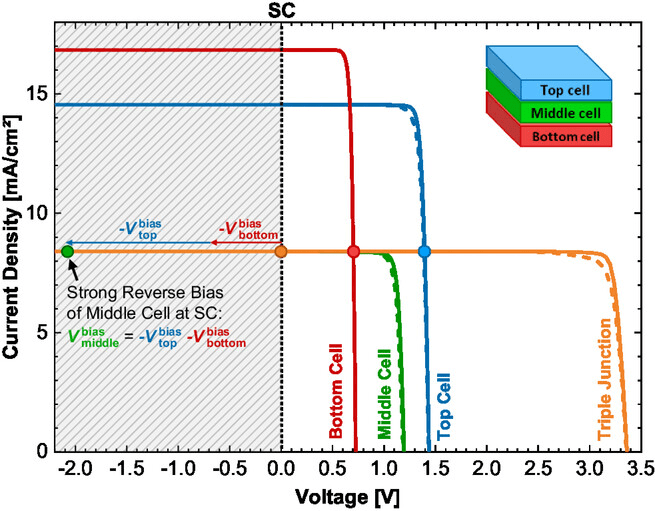
A two-terminal multi-junction solar cell in general is subjected to current mismatch-induced reverse bias, potentially leading to breakdown of its limiting subcells. This can be more critical in triple-junction compared to the dual-junction solar cells as the limiting subcell might work at a higher reverse bias (sum of the voltages of the other two subcells).  Since the perovskite solar cell is known to have a low breakdown voltage, it is necessary to study such effects at this early stage of development.

In this work, the possibility of junction breakdown during current–voltage measurements of perovskite/perovskite/silicon triple-junction solar cells through simulations and experimental demonstrations is investigated.

Check out the full paper here: https://onlinelibrary.wiley.com/doi/full/10.1002/solr.202400376

New Paper- Tailoring perovskite crystallization and interfacial passivation in efficient, fully textured perovskite silicon tandem solar cells

Fully textured perovskite silicon tandem solar cells rely on the deposition of the perovskite absorber on textured silicon with a >1 μm pyramid size, which represents the current standard in the industry. To bridge the gap between research and industry, these cells must demonstrate a high power output. Nevertheless, perovskite absorbers deposited on large pyramids often suffer from a high grain boundary defect density and poor interfacial passivation at the perovskite/electron transport layer (C60) junction. In our recent work, we tackle both loss mechanisms by introducing a multi-functional additive (urea), which simultaneously regulates the perovskite crystallization as well as passivates the perovskite/C60 interface. Moreover, this strategy is employed at a low annealing temperature (100°C, different from the standardly used 150°C), thus enabling an effective lowering of the perovskite annealing’s thermal budget. This approach is of high relevance for the industrialization of perovskite silicon tandem solar cells.

Check out the full paper here: