New Paper- Toward efficient and industrially compatible fully textured perovskite silicon tandem solar cells: Controlled process parameters for reliable perovskite formation

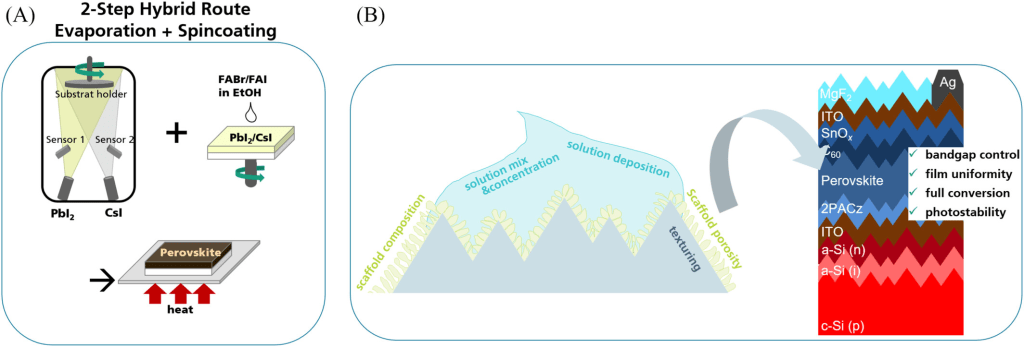
Monolithic perovskite silicon tandem solar cells with the fully-textured architecture are promising due to their efficient light management scheme as well as compatibility to industrial silicon production lines. To achieve high-efficiency, and more importantly reproducibility, perovskite deposition parameters should be well controlled. In the recently published paper, we look into the impact of perovskite process parameters (with the hybrid evaporation/spincoating method) on the final film’s crystallinity, morphology, and optoelectronic quality. Furthermore, we investigate the impact of the underlying silicon texture on the perovskite’s homogeneity and phase purity. Overall, the work provides important insights for ensuring reliable perovskite formation with the hybrid method.

https://doi.org/10.1002/pip.3770

New Paper- Recent Progress in Monolithic Two-Terminal Perovskite-Based Triple-Junction Solar Cells

The highly efficient perovskite-based dual-junction solar cells especially on silicon bottom cell have shown impressive PCE improvement in recent years with world record of 33.9%. Now a new group of perovskite solar cells is emerging: triple-junction solar cells with the potential to surpass the efficiency limit of dual-junction solar cells.

In our recent review, we discussed the status of perovskite based 3J solar cells, their theoretical potential, and how to precisely characterise them.

https://doi.org/10.1039/D3EE02822D

New Paper – Loss Analysis of Fully-Textured Perovskite Silicon Tandem Solar Cells

Our PhD student Oussama Er-raji along with Dr. Christoph Messmer and their collaborators published a new work where they used various characterisation techniques to investigate loss origins in fully-textured perovskite-silicon tandem solar cells. By feeding the extracted device characteristic parameters into a Sentaurus TCAD opto-electrical model, the study delivered precise steps required to reach the practical efficiency potential for this technology calculated to be 39.5%. This work will help to prioritise optimisation pathways to accelerate the development of perovskite-silicon tandem solar cells towards their practical limit.

https://onlinelibrary.wiley.com/doi/abs/10.1002/solr.202300659

On Air – “Science S*heroes” Podcast interview with Juliane

Recently, Juliane had the opportunity to chat to Christiane Attig and Rebecca Moltmann from the German science podcast “Science S*heroes”. The result is a fun conversation spanning a wide range of topics from current solar cell research, to the best way to make hot chocolate. Have a listen to find out more!

“Strom. Immer Strom.” – Solarzellen, Energieeffizienz und schöne physikalische Strukturen

New Paper – Perovskite/Perovskite/Silicon Triple-Junction Solar Cells reach Open Circuit Voltage over 2.8V

In our most recent publication we demonstrate that triple-junction solar cells consisting of perovskite-perovskite-silicon subcells hold considerable promise and have great efficiency potential. We were able to develop a triple-junction solar cell with an open-circuit voltage of over 2.8 volts, using adapted deposition techniques to sucessfully deposit the large number of layers needed for a triple junction solar cell. This record figure confirms that this soalr cell has excellent material properties for generating electricity. This research is part of the Triumph research project funded by the European Commission and the RIESEN research project funded by the German Federal Ministry for Economic Affairs and Climate Action.

https://pubs.acs.org/doi/10.1021/acsenergylett.3c01391

New Paper – Improving transparent conductive oxides to reduce losses in tandem solar cells

In her newest paper PhD student Özde Kabaklı published important work to improve the transparent conductive oxide films used in perovskite-silicon tandem solar cells. She and her collaborators were able to reduce the electro-optical losses in these layers. This will help built better tandem solar cells. You can find all the details here: https://www.sciencedirect.com/science/article/abs/pii/S0927024823000673

New paper – Increasing the Current Density in Tandem Perovskite-Silicon Solar Cells

PhD student Mina Heydarian and her collaborators published a new study in which they carefully modelled how to increase the current density in tandem solar cells and then optimised the experimental procedures to realise great gains in the current density. These improvements are key to realise highly-efficient perovskite-silicon solar cells. The study also demonstrates the importance of bringing together experts in modelling, fabrication and characterisation. Read the full paper here: https://onlinelibrary.wiley.com/doi/full/10.1002/solr.202200930

In the press – Juliane’s start in Freiburg and the support by the Vector Stiftung make the news

In Summer 2022 Dr Juliane Borchert started at the University of Freiburg to set up her new lab with the generous support of the Vector Foundation and the Technical Faculty of the University of Freiburg. Read more about her background and her plans here: Press report Uni Freiburg

New Poem: Eight Minutes Twenty Seconds

Eight Minutes Twenty Seconds (2020)

For a long time I’ve been struggling
Struggling to reach the surface
Constantly losing myself
To suddenly reappear
Being absorbed and re-emitted
Absorbed and re-emitted
For ten thousands of years
Absorbed and re-emitted
Constantly losing myself
To suddenly reappear

Now I have emerged at the surface
Of the star you call the Sun
As I surface, I am not alone
Many, many, many, oh so many other photons are emerging with me
We are tiny, mass less, restless packets of energy
Flecks of light
All with different colours, wavelengths, trajectories
We have all been struggling for a long time
We are all energized and ready to go

And so we go
Hurled away from the Sun at unimaginable speed
Our speed
The speed of light
In eight minutes and twenty seconds I will reach the planet you call Earth
Most of us will not get there
Only one billionth of us will arrive at the little blue marble you cling to
Imagine, all of you (and I don’t mean you in this room, I mean all 8 billion of you)
Would take off in the same second
But only 1,2,3,4,5,6,7,8 of you would reach your destination
That’s how many of my siblings I will have lost sight off
When I reach Earth, in eight minutes and twenty seconds

What will I do when I get there?
I could donate my energy to a plant
It will dutifully absorb it in its chlorophyll and store it in sugar, starch or oil
For you to feast on

I could get reflected off the ground
Flung back into space to travel to an unknown destination

I could hit a puddle and get absorbed by a molecule of water
As it takes me in it would dance and vibrate
until it jumps out of the puddle to float off into thin air
Leaving parched dirt behind

Or I could fall on you
Maybe I’d just warm your skin
Maybe I’d break a tiny, unimportant bond
In a strand of your DNA
Which one day will prove not to be that unimportant after all
Then, as your cancer grows,
You would curse the day you met me

Or I maybe I’ll just reflect off a lovely flower
And right into your eye
Where you sense me
And together with a million of my siblings
I would let you see
The most beautiful flower you’ve ever seen

Who knows what I’ll do?
All I know is that I’ve been
Struggling for a long, long time
And in eight minutes and twenty seconds
I will reach you

Poem: An indictment of monolingual anglophones

An indictment of monolingual anglophones
(present company of course excluded)
(2019)

Once when I was fifteen
I nearly had a visa application denied
not because of anything wrong with my paperwork,
or my pass-photo,
or my fingerprints,
it wasn’t even that I had mistakenly ended up on a watchlist.
It was just that I didn’t recognise my name.
You and your ancient loudspeaker had twisted it
distorted and compressed
you spat out my name,
like your cat coughs up hairballs
full of tiny bones and bits of fur.
Even I couldn’t recognise it any more

I didn’t react
didn’t go to the right room
didn’t follow your instructions.
So you coughed it up again
spat it out louder,
scratching and screeching
it landed right in front of me
and I finally had a faint sense of recognition
realized that this crumbled up,
moist, disgusting pile of syllables
was supposed to be
my name.

Now you ask for my surname
I say it and without skipping a beat
start spelling it
because I know if I don’t
the question mark on your face will grow
and turn into a frown
and you will look at me
as if it is my fault
that you can not fathom how
to transcribe the sounds I made
into letters
that you can find on your list.
So I start spelling

You introduce me to your friend
and say my name correctly, almost.
Your friend doesn’t understand
and makes me repeat,
and repeat,
and repeat.
You say it again correctly, almost.
I repeat,
and repeat.
I finally say: It is like Julia just with an extra N and E
and not pronounced like Julia.
And you two laugh.
I join in,
just a beat too late.

You should be using my surname
it would be the appropriate, professional thing to do
but you haven’t got a clue
how to begin to pronounce it
so you try to avoid embarrassment
and opt for my first name
which on paper appears easier
but you still twist it up
not quite beyond recognition
but beyond resonance

I’ve come to realise
that my surname is gone
can’t be rescued
is fading away.
You all just can’t cope with it.
The B and o are almost palatable
but then the
r combined with a ch
completely throws you
the e that is just a short “e”
and really doesn’t need emphasising
and finally
the r and t that finish it all off
are just too much for you.
You’ve never learned to speak another language.
You’ve never learned to listen closely enough
to be able to reproduce the sounds
that I make when I say my surname.
My surname is not salvageable
it is just too much for you
it is a lost cause.

But maybe my first name can be rescued.
Maybe if I altered the vowels to fit better with what you expect
maybe if I started using my second name which doesn’t feel like mine
but is more familiar to your tongues
maybe if I started to just let you call me Julia
you wouldn’t so often ask me where I am from.

Cause when you look at me
I am white enough that you think I am “from here”
When I speak and am careful and don’t mess up
You will continue to think I belong
But when I say my name
you know
you know I am not “really” from here
and then the questions begin
Where are you from?
How long have you been here?
What are you doing here?
When are you going back?
All seemingly harmless but every time you say them
they sound more and more like:
Should you have come here?
Should we have let you?
Are you a skilled, contributing, worthy person?
Do you really believe you are allowed to belong here?
Because my name doesn’t
It doesn’t fit in
It doesn’t belong here

So will I
Anna
Juliane
Borchert

daughter of
Johanna
Dorothea
Sigrid
Luise
Charlotte
and
Burkhart
Hermann
Christian
Borchert

ever belong here?

12.3.2019